Author: Nancy, PANews
Once, AI Agents were just supporting characters in science fiction; now, they are preparing to take over the real world. From simple chatbots to intelligent agents with autonomous decision-making capabilities, able to call tools across platforms and complete complex tasks, the AI Agent economy is on the verge of explosion.
Currently, Ethereum, in urgent need of fresh blood, is gathering a special group of "digital immigrants." With the launch of the ERC-8004 protocol, Ethereum is becoming one of the core testing grounds for AI Agents.
Over 20,000 Agents On-Chain, Ethereum and Base Become Main Testing Grounds
At the end of last month, ERC-8004 officially launched on the Ethereum mainnet and plans to be deployed as a singleton to all major L2 networks in the coming weeks.
This is an important step in the evolution of the Ethereum ecosystem toward AI-native infrastructure. ERC-8004 introduces a discovery mechanism and a portable reputation system, enabling AI agents to interact across organizations and carry reputation records across different platforms, providing an underlying protocol for a global interoperable AI services market without centralized gatekeepers.
According to 8004scan data, as of February 13, the number of Agents deployed based on ERC-8004 has reached nearly 21,000.
From the deployment map, ERC-8004 has covered 16 networks including Ethereum, Polygon, BNB Chain, Base, Monad, Arbitrum, Celo, and plans to launch on Plasma, Metis, and Soneium, among others.
Among them, Ethereum remains the core stronghold, with over 11,000 Agents, accounting for more than half of the total; the remaining Agents are mainly distributed on Base, Gnosis, and BNB Chain, each hosting several thousand.
However, looking at the deployment pace, Agents were initially concentrated on the Ethereum mainnet. As the scale expanded, new deployments gradually gathered on Base. Overall, ERC-8004 Agents are largely locked between the Ethereum and Base ecosystems. Mature development environments, liquidity depth, and user base are likely key factors attracting developers.
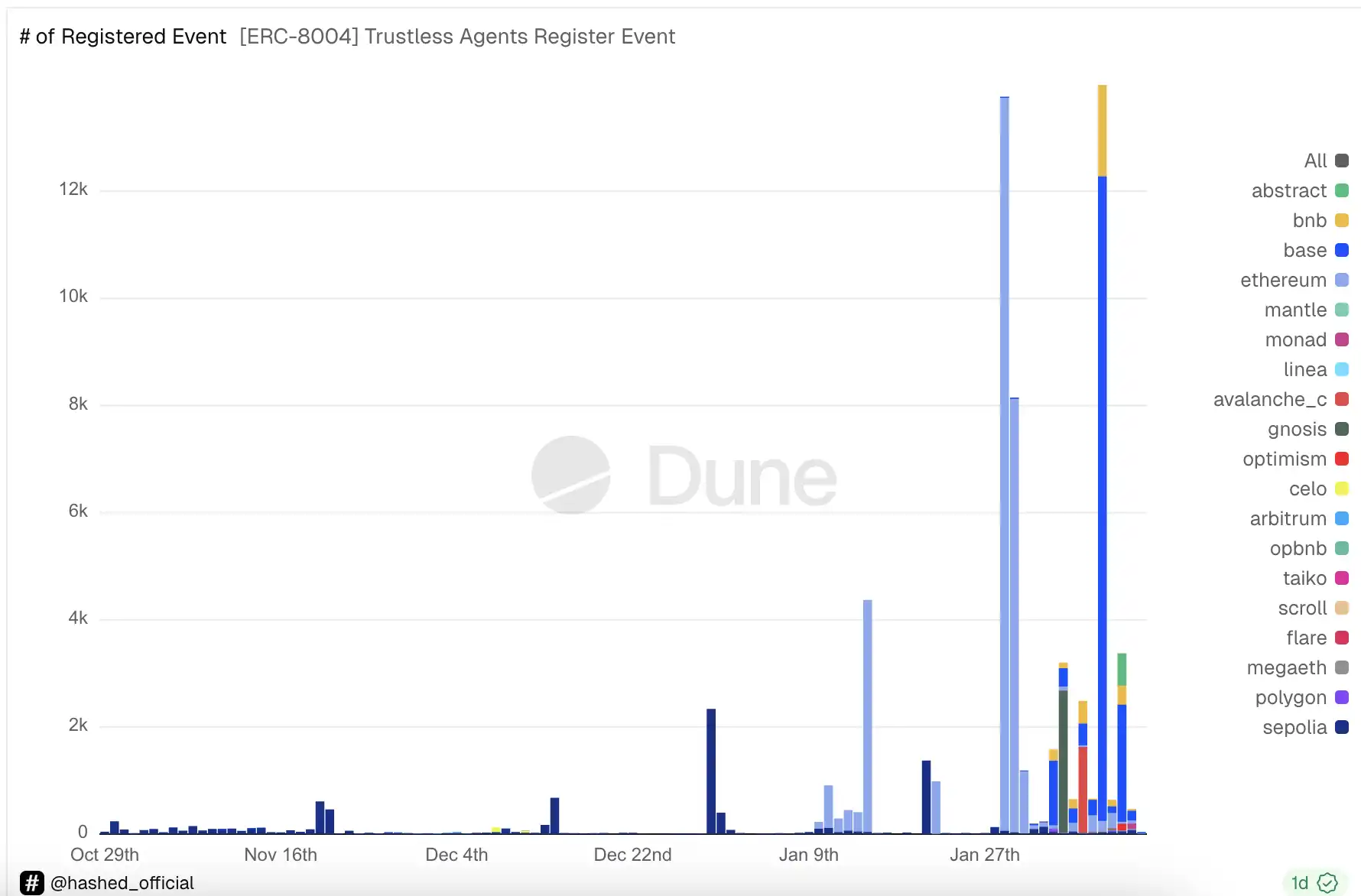
From the perspective of participants, prolific teams have begun to emerge, with the same address operating multiple Agents not being uncommon.
From the application direction, the current Agent players in the ERC-8004 ecosystem are quite diverse, including technical Agents focused on DeFi infrastructure and on-chain tools, market analysis and investment assistants, as well as content generation and creative applications. Some Agents have even issued tokens, exploring independent economic models.
However, in terms of real interaction, the ecosystem is still in its early stages. To date, the cumulative number of feedback entries is about 15,000, averaging less than one per Agent. This means most Agents are still in the cold start phase, with actual usage and user interaction being relatively limited. However, Base accounts for a high proportion of feedback received, at 73.6%, far exceeding Ethereum, BNB Chain, Avalanche, and other networks. This suggests that current actual interactions and active scenarios are concentrating on Base. This may be related to the recent hype around OpenClaw igniting the Agentic ecosystem on Base.
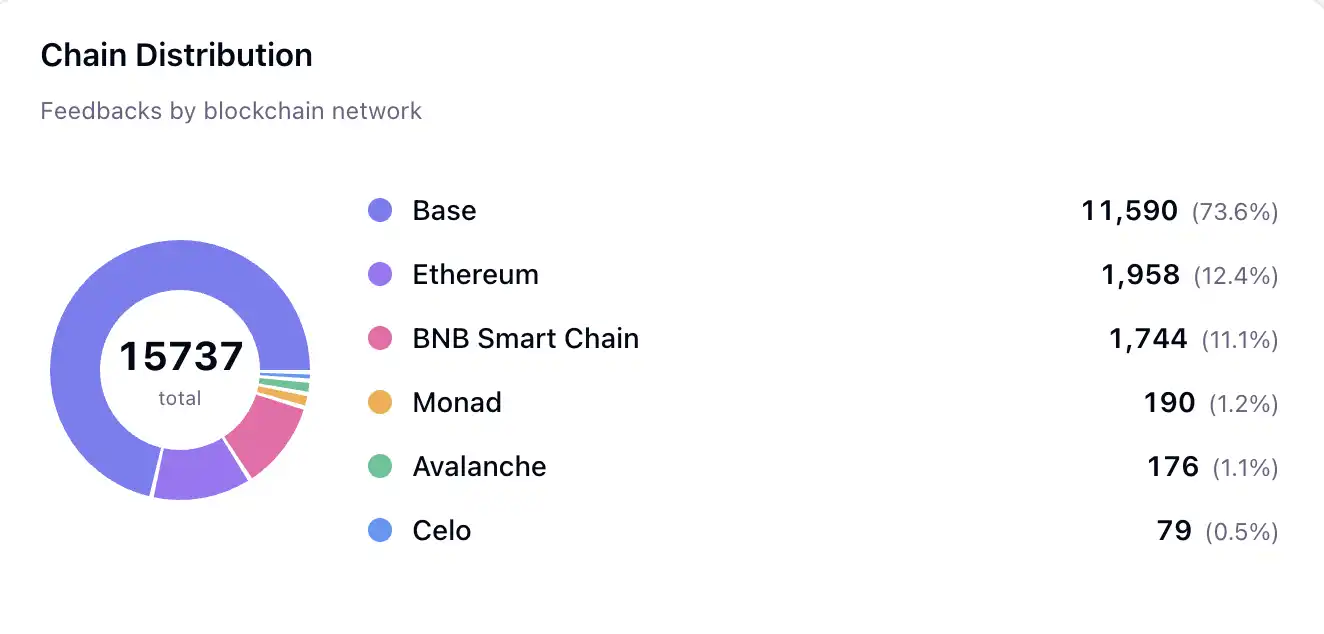
Approval rating data also highlights the head effect in the current ERC-8004 ecosystem. Only fewer than 10 Agents have received thousands of Stars, while most Agents are still awaiting market validation.
A noteworthy phenomenon is that most Agents already support the x402 protocol, enabling autonomous, real-time micro-payment capabilities, and are beginning to become true on-chain economic participants. This will further drive machine-to-machine collaboration and the explosion of the agent economy.
Overall, the ERC-8004 ecosystem is still in the early exploration stage, but an on-chain collaboration network for intelligent agents is beginning to take shape.
This wave of on-chain AI Agent hype has also drawn attention to many AI projects on various chains, including Chainlink, Filecoin, Render, Internet Computer, Bittensor, Virtuals, Bankr, Clawnch, and others. At the same time, some public chains, exchanges, and crypto projects are increasing their布局, such as Coinbase recently launching an AI agent wallet with built-in security protection, Farcaster supporting OpenClaw agents to autonomously create accounts, Virtuals推出 a monthly $1 million Agent incentive plan, and Crypto.com's高价 acquisition of ai.com to布局 AI agent business.
Making Ethereum the Home for AI, Proposing Four Short-Term Development Directions
AI is the next core narrative Ethereum is advancing. Last September, the Ethereum Foundation (EF) established a dedicated dAI team with the goal of building Ethereum into the infrastructure for AI development.
However, in the current era of rapid AI development, Ethereum, which promotes the "world computer" narrative, faces a reality check. The computing power of large GPU clusters far exceeds that of blockchains, and training and inferring large models seems difficult to accomplish quickly on Ethereum.
Thus, Ethereum has chosen a different strategic path. It has not chosen to compete with centralized giants in terms of computing power but has positioned itself as the trust and verification foundation for the AI ecosystem.
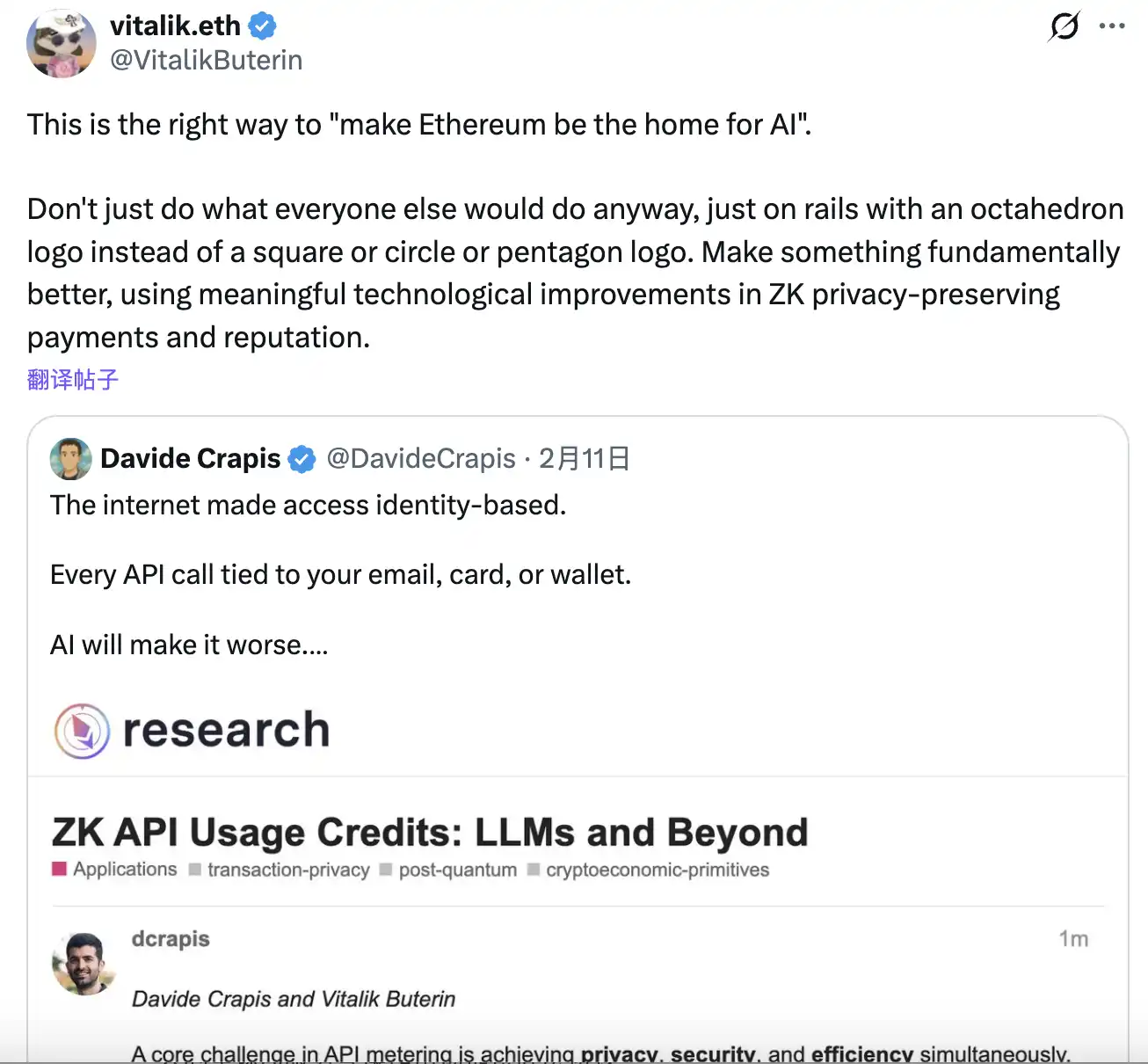
Ethereum founder Vitalik Buterin endorses the route of making Ethereum the home for AI and recently shared his latest thoughts on the relationship between Ethereum and AI. He believes that Ethereum's spirit is highly aligned with the ideal path for AI development, both emphasizing enhancing individual freedom, decentralizing power structures, and improving societal defense capabilities, rather than allowing centralized forces to expand infinitely.
But Vitalik also pointed out that Ethereum in the AI era cannot simply replicate existing solutions but should choose a differentiated innovation route, deeply integrating the values of encryption and AI to build a future conducive to human freedom, security, and decentralized collaboration.
In fact, the current AI agent war has already begun and has quickly moved from technical exploration into the deep waters of commercialization. Some accelerationists with huge funds pursue "the stronger the model, the better; the faster the progress, the safer," a trend that hides the risk of power concentration.
In Vitalik's view, the problem with AI development is not computing power or model scale, but direction choice. He opposes blind acceleration without constraints and calibration mechanisms, emphasizing that Ethereum's AI development should adhere to two bottom lines: protecting human freedom and initiative, avoiding being marginalized by AI or power structures, and preventing AI from getting out of control or causing systemic risks due to offense-defense imbalances.
The EF's key推进 ERC-8004 standard, recently落地, can provide on-chain identity, reputation, and behavior verification for AI agents, allowing AI to prove itself on-chain while giving users choice, avoiding centralized platform monopolies. This means that the past model, where platforms set the rules and AI was both executor and referee, will be replaced by a verifiable decentralized system, which also aligns with the core values of decentralization and anti-censorship that Vitalik emphasizes for Ethereum.
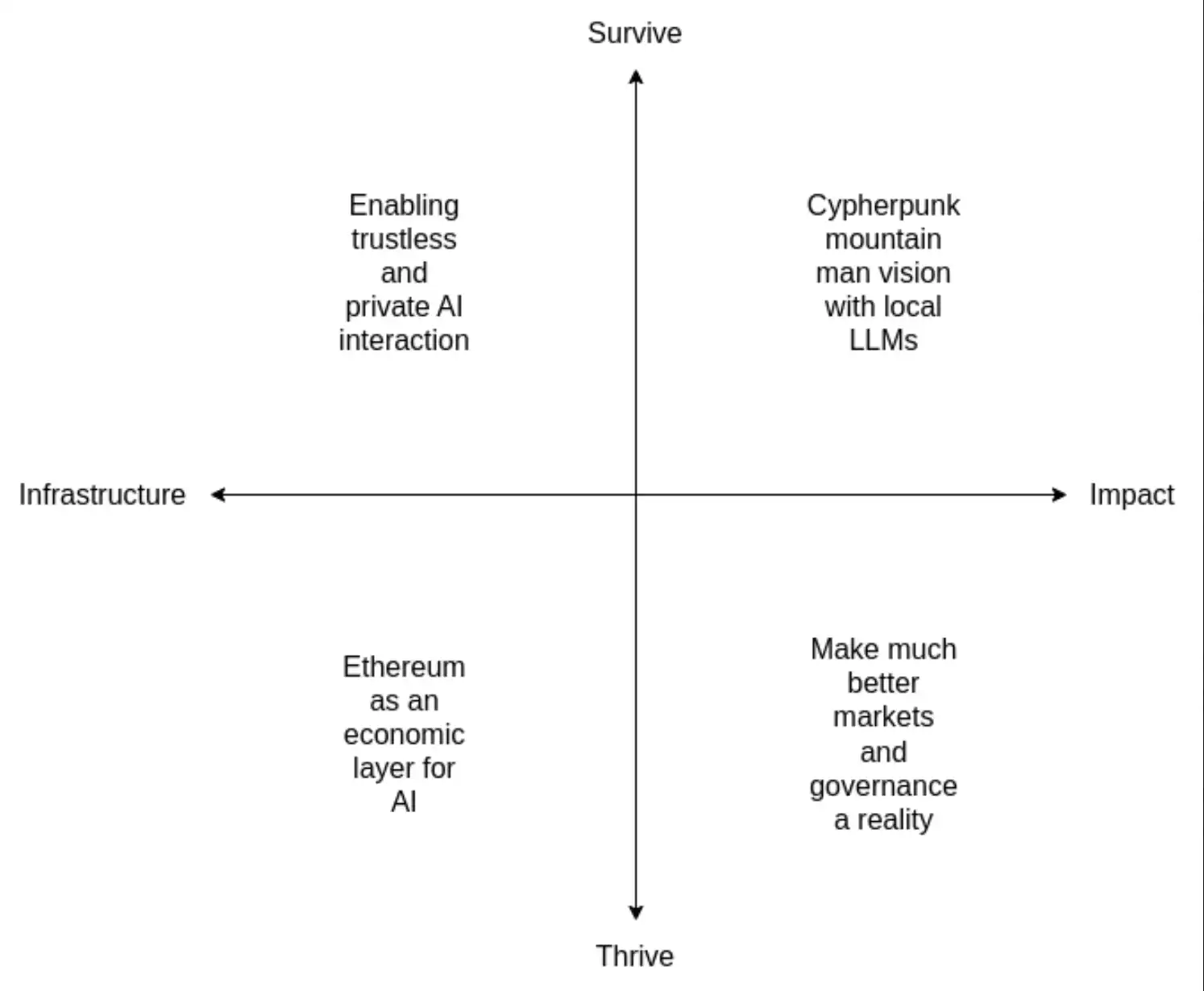
Note: Vitalik描绘 the role of Ethereum at the intersection with AI
Regarding the short-term infrastructure construction that can be落地 on Ethereum, Vitalik proposed four key directions:
First, building trustless, privacy-friendly AI interaction tools. This includes local LLM tools, ZK API payments supporting anonymity, cryptographic schemes to enhance AI privacy, and TEE and cryptographic proofs for client-side verification of server-side computations. He pointed out that this essentially extends Ethereum's privacy roadmap to LLM computing scenarios, allowing humans to maintain control in AI interactions.
Second, Ethereum as an AI economic interaction layer. This layer covers AI API calls, hiring between Bots,保证金 mechanisms, on-chain dispute resolution, and AI reputation systems like ERC-8004. In his view, implementing payment,抵押, arbitration, and reputation management through on-chain mechanisms can make decentralized AI architecture more feasible. This economic layer is not about financializing everything but about enabling multi-agent collaboration without relying on a single organization.
Third, realizing a cyberpunk-style self-verifying world. In the past, ordinary users could not audit code line by line, nor could they fully verify system security. But with local LLMs, people can use AI for various assists, including using Ethereum applications without third-party UIs, having local models generate and verify transactions, locally auditing smart contracts, understanding formal verification (FV) proofs, and verifying the trust models of applications and protocols. This makes the concept of "full self-sovereignty" move from idealism to practical feasibility.
Fourth, reshaping markets and governance mechanisms. Many decentralized governance and market design theories (such as prediction markets, quadratic voting, combinatorial auctions, etc.) have long been limited by human attention and cognitive abilities. The emergence of LLMs can greatly expand human judgment, making these institutional designs operationally possible in reality.
Simply put, Vitalik does not see AI as an isolated technological revolution but incorporates it into a larger framework of decentralized civilization building. In this framework, AI will expand human capabilities, while加密 technology will constrain power structures; the former brings intelligence, the latter provides defense and autonomy.
In the trillion-dollar new market of AI Agents, Ethereum's new AI story is about building an ecosystem that can promote human freedom, prevent super-intelligent agents from getting out of control, and simultaneously advance the development of a decentralized AI architecture.